
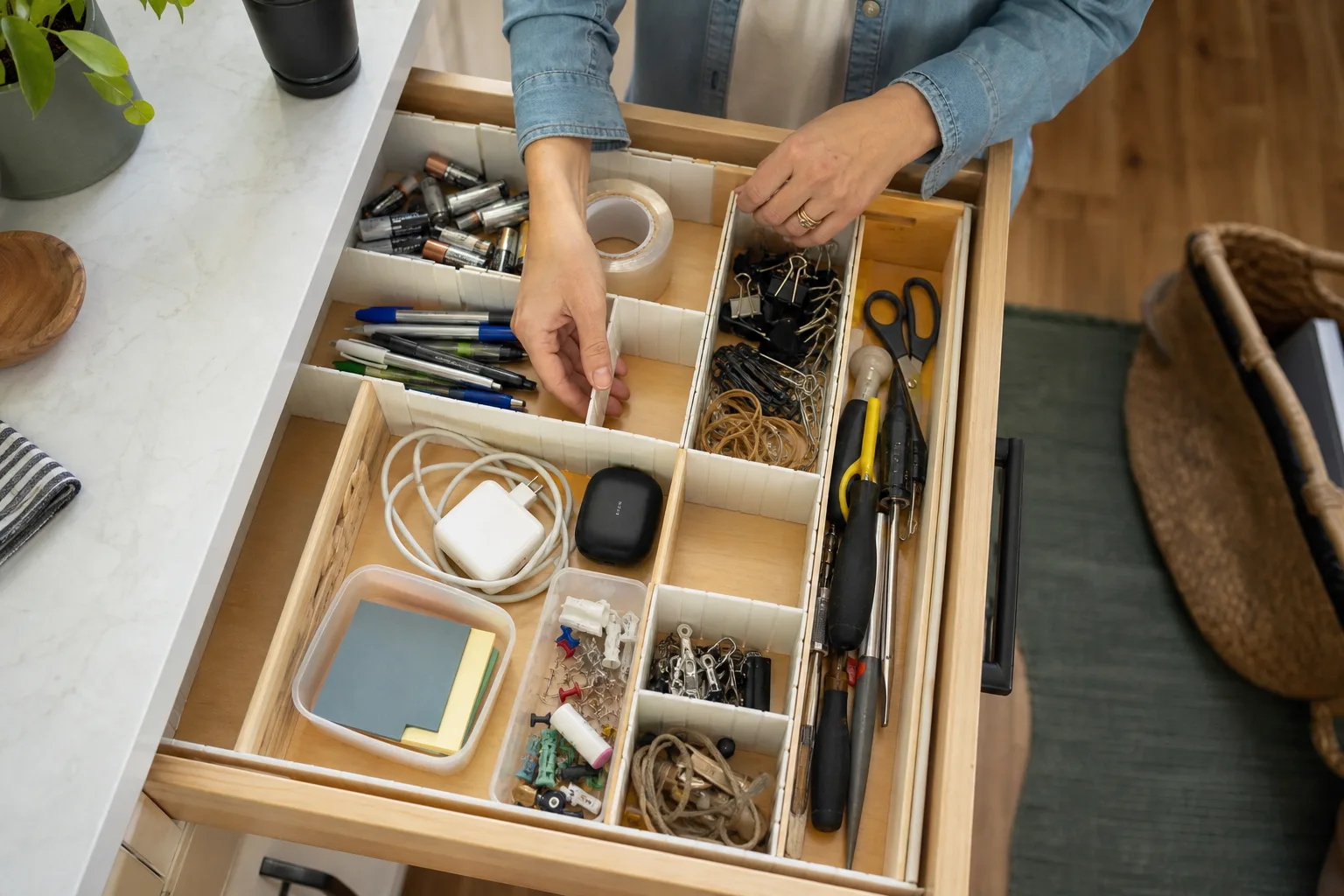
The tape is beneath the batteries, three pens do not write, and an unfamiliar cable has survived two moves. Dividers cannot fix this until the drawer has a clear purpose and every section represents an action the household actually performs.
This guide does not claim hands-on testing of every option on the market. It translates an everyday household problem into a practical buying checklist, so you can compare current products against your own room, routine, and tolerance for maintenance.
The quick answer
Empty, edit, and group before buying. Adjustable dividers suit changing categories; modular trays suit many small objects. Leave one flexible section for the odd item that is useful but does not deserve its own container.
What to look for before you buy
Start with the constraint that creates the most friction in your home. A feature is valuable only when it changes that constraint without adding a harder storage or cleaning problem.
Measure all three axes
Drawer width, depth, and usable height matter. Include screw heads, curved corners, and clearance beneath the counter.
Group by use
Keep scissors with tape, not with every metal object. Action-based groups make retrieval more intuitive.
Control tiny items
Small removable cups keep clips, keys, and batteries from rolling under longer tools.
Choose by household scenario
The same product format can be helpful in one room and irritating in another. Use these scenarios as a shortlist, then verify dimensions, care instructions, and current availability on the seller or manufacturer page.
Changing household
Spring-loaded or movable dividers let categories expand without replacing the whole system.
Shallow drawer
Low trays make every item visible and prevent tall containers from scraping above.
Deep utility drawer
Long dividers create lanes for tools, with cups inside one lane for small parts.
What not to overpay for
A long feature list can distract from fit. Skip complexity that does not remove a repeated household step, and be cautious when a specialized replacement part is essential to basic use.
- Buying a tray with dozens of tiny compartments before sorting.
- Keeping expired batteries mixed with usable ones.
- Filling every square inch so new useful items have nowhere to land.
Make the purchase survive real life
Use a one-minute rule: when an item enters the drawer, remove one duplicate or dead item if the category is crowded. Review mystery cables and keys quarterly, labeling anything worth keeping.
Before ordering, take one final measurement and decide where the item will live when it is not being used. That single decision prevents many useful products from becoming visible clutter.
Frequently asked questions
Are bamboo dividers better than plastic trays?
Neither is universal. Dividers are flexible; trays control small items. Consider cleaning, fit, and category size.
How many sections should a junk drawer have?
Usually five to eight purposeful groups are easier to maintain than many narrow cells.
Should batteries stay in the junk drawer?
Store them according to manufacturer guidance, protected from metal contact, heat, and access by children.
Keep reading
Related guides
 Organization
Closet Bins That Make Sense for Real Morning Routines
Use open access, visible categories, and reachable heights so storage supports getting dressed instead of hiding the clothes you need.
Read guide → Organization
Shoe Storage for Narrow Entryways and Busy Households
Keep the active rotation near the door while protecting a clear walking path and giving wet footwear room to dry.
Read guide → Organization
Shelf Risers: The Cheapest Way to Find Hidden Cabinet Space
Use risers to separate stacks you reach differently, not simply to fill every inch of air inside a cabinet.
Read guide →